Call for Papers
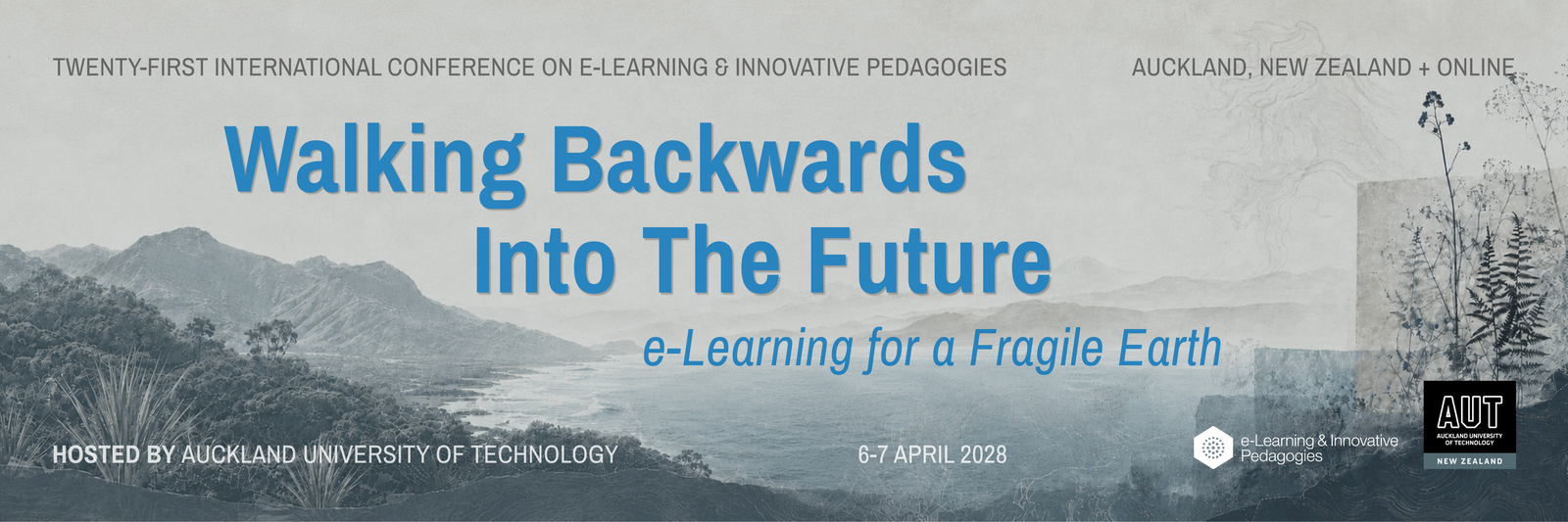
We invite you to join us for the Twenty-first International Conference on e-Learning & Innovative Pedagogies, the annual meeting of the e-Learning & Innovative Pedagogies Research Network, hosted by Auckland University of Technology, taking place in Auckland, New Zealand, and online, 6–7 April 2028. The conference is part of an annual paired gathering with the International Conference on Technology, Knowledge, and Society, bringing together overlapping communities of inquiry around learning, technology, knowledge systems, and social change.
The e-Learning & Innovative Pedagogies Research Network is a leading international meeting place for researchers, educators, learning designers, technologists, policymakers, community leaders, and practitioners working across the changing landscapes of learning. The conference welcomes proposals that address education not only as a system of instruction, but as a social, cultural, ecological, technological, and ethical practice.
Special Focus
The 2028 special focus, Walking Backwards Into the Future: e-Learning for a Fragile Earth, invites participants to examine how digital learning can respond to ecological, cultural, technological, and democratic challenges.
This special focus is inspired by the languages and cultures of the Pacific, in which humans face the past, which we can see and from which we can learn, while walking backwards into the future, which is unknown and hidden from our view. These themes invite exploration of how digital technologies can enhance Indigenous, ecological, and democratic possibilities through innovative approaches in education.
In this context, e-learning is not only a matter of platforms, tools, or delivery systems. It is also about relationships, knowledge traditions, access, participation, care, and responsibility. Digital technologies can widen educational possibilities, but they also raise urgent questions about equity, culture, environment, data, automation, and the purposes of learning itself.
This special focus invites critical and practical conversations about how education can draw from the past while responding to an uncertain future. How can digital technologies enhance Indigenous, ecological, and democratic possibilities? How can online and hybrid learning remain grounded in place, community, and lived experience? How can educators respond to artificial intelligence while preserving human judgment, cultural memory, and ethical responsibility? What kinds of pedagogy are needed for a fragile Earth?
We welcome proposals that address e-learning as a technological practice, a cultural practice, a civic practice, and a way of imagining more sustainable educational futures.
Themes:
- Theme 1: Ancestral Wisdom in the Age of AI
- Theme 2: Place-based Education and Digital Technologies
- Theme 3: Innovative Approaches to Ecopedagogy and Environmental Education
- Theme 4: Pedagogies, Participation, and Possibilities
We also welcome proposals addressing the core themes of the e-Learning & Innovative Pedagogies Research Network, including digital pedagogies, new digital institutions and spaces, technologies of mediation, and the design of social transformations in learning.
Knowledge Experience and Format
The conference is organized as a hybrid knowledge experience, integrating in-person and online participation within a unified scholarly environment.
For in-person delegates in Auckland, the conference is designed as a human-scale gathering shaped by conversation, shared inquiry, and place-based exchange. Sessions, talking circles, breaks, and informal encounters create opportunities to connect educational research with teaching practice, learning design, technology, community knowledge, and the real-world systems that shape education.
For online delegates, the conference is more than a remote viewing option. Accepted proposals become Presentation Pages where presenters share abstracts, media, and supporting materials. Delegates participate through live online sessions, asynchronous engagement, and discussion spaces that remain available before, during, and after the event.
Across both formats, the emphasis is on reciprocal exchange rather than one-way presentation. Whether joining in Auckland or online, participants are part of a shared knowledge environment where ideas can be presented, discussed, revisited, and developed into future collaborations, publications, teaching practices, policy conversations, and community initiatives.
Publication Pathways
All accepted proposals are included in the conference proceedings, providing a formal record of the conference program and presentation abstracts. Proceedings offer a way for presenters to make their work discoverable as part of the annual knowledge record of the Research Network.
Presenters are invited to further develop their conference work for possible publication in Ubiquitous Learning: An International Journal, the peer-reviewed journal of the e-Learning & Innovative Pedagogies Research Network.
Participants may also propose longer-form projects for thee-Learning & Innovative Pedagogies Book Imprint, which publishes monographs and edited collections focused on digital learning, innovative pedagogy, educational technology, curriculum, assessment, learner diversity, professional learning, and educational change.
A Member-Based Research Community
Membership in the e-Learning & Innovative Pedagogies Research Network provides year-round access to the community, publications, and programs that support the conference. Members receive benefits including a conference registration discount, access to digital media archives from past conferences, publishing pathway benefits, online programming, Network updates, and opportunities to grow their professional network in person and online. Membership also includes personal electronic access to journal and book content published by the Research Network.
Membership in the e-Learning & Innovative Pedagogies Research Network is included in all conference Presenter Passes
Join Us
We warmly invite you to submit a proposal and join us, either in Auckland or online, for the Twenty-first International Conference on e-Learning & Innovative Pedagogies.
Together, we will examine how education can walk backwards into the future — learning from the past, engaging the possibilities of technology, and shaping more careful, connected, and sustainable futures for a fragile Earth.
Sincerely,
Dr. Georgina Tuari Stewart, Local Conference Committee, Auckland University of Technology, New Zealand
Dr. Fiona Westbrook, Local Conference Committee, Auckland University of Technology, New Zealand
Dr. Lincoln Dam, Local Conference Committee, Auckland University of Technology, New Zealand
Dr. Selena Meiklejohn-Whiu, Local Conference Committee, Auckland University of Technology, New Zealand
Dr. Karen Finn, Local Conference Committee, Auckland University of Technology, New Zealand
Dr. Bill Cope, Research Network Chair, University of Illinois at Urbana-Champaign, United States of America
Dr. Mary Kalantzis, Research Network Chair, University of Illinois at Urbana-Champaign, United States of America